Enter password to view case study
Get Moments —
Product Partnership
& UX Design
Get Moments —
Product Partnership
& UX Design
Two founders. One big idea. Eleven months of building it together.
Two founders. One big idea. Eleven months of building it together.
CONTEXT
Live events startup, mobile design, platform design ,
2023–2024
Live events startup · mobile design · platform design · 2023–2024
SCOPE
Product Strategy · UX Design · ui design · Facilitation · user testing
Table of Contents
01 — What they were building
02 — What they needed
03 — How we actually worked
04 — The mobile app
05 — The organizer platform
06 — Škoda Karaoke
07 — What launched at Sziget
08 — What this kind of partnership requires
The product
Get Moments is a simple idea with complex execution.
Get Moments is a simple idea with complex execution.
You're at a concert. You record a clip on your phone.
So does everyone else.
You're at a concert. You record a clip on your phone. So does everyone else.
Get Moments collects all of it — fan footage, organizer content, professional material — and turns it into one official video of the event. Delivered to everyone who was there.
Get Moments collects all of it — fan footage, organizer content,
professional material — and turns it into one official video of the event. Delivered to everyone who was there.
The memory of the moment, made whole.
The memory of the moment, made whole.
Two co-founders
One running the business. One building the technology.
One running the business. One building the technology.
They had the vision, the energy, and the complementary skills to make something real.
They had the vision, the energy, and the complementary skills to make something real.
What they didn't have was a design voice — someone who could represent the user and translate that into a product both sides could build toward.
What they didn't have was a design voice — someone who could represent the user and translate that into a product both sides could build toward.
They wanted UX design.
That's how the brief was framed.
What they actually needed was someone who could sit between the business thinking and the technical thinking — and make sure the product that emerged from that gap was one users would actually want to use, built on the right UX principles and patterns from the start.
Three different realities. Each one internally consistent. Each one pointing in a different direction.
We had 100+ conversations
Every call, I came prepared — something new in Figma, a screen, a flow, a direction to react to.
Every call, I came prepared — something new in Figma, a screen, a flow, a direction to react to.
We never talked in the abstract.
We talked about what was in front of us.
We never talked in the abstract.
We talked about what was in front of us.
Sometimes we moved fast.
Sometimes we spent an entire call on one decision that looked small and wasn't.
Sometimes we moved fast.
Sometimes we spent an entire call on one decision that looked small and wasn't.
I wasn't a contractor executing a brief.
I was an essential voice in every conversation — the one asking: but what does the user actually need here?
I wasn't a contractor executing a brief.
I was an essential voice in every conversation — the one asking: but what does the user actually need here?
How we worked
The business co-founder brought commercial instinct.
The technical co-founder brought what was buildable.
I brought design thinking and a user perspective.
The business co-founder brought commercial instinct. The technical co-founder brought what was buildable. I brought design thinking and a user perspective.
None of us were always right. All of us were genuinely listened to.
None of us were always right. All of us were genuinely listened to.
When conversations got intense — and sometimes they did — we said so. We apologised when it was needed. Both ways. We iterated, and iterated, and kept moving — even when the steps were small.
When conversations got intense — and sometimes they did — we said so. We apologised when it was needed. Both ways. We iterated, and iterated, and kept moving — even when the steps were small.
That kind of working dynamic doesn't happen by accident. It's built, call by call, decision by decision.
That kind of working dynamic doesn't happen by accident. It's built, call by call, decision by decision.
What I held
My job, underneath the design work, was to hold three things at once and to keep bringing those three things into the same room — especially when the product felt like it could go in ten directions at once.
Three different realities. Each one internally consistent. Each one pointing in a different direction.
One: User + design patterns
What users would need and expect — navigating by design patterns
and facilitating the conversation about user needs when hard evidence wasn't yet available.
What users would need and expect — navigating by design patterns and facilitating the conversation about user needs when hard evidence wasn't yet available.
two: business
Where the business wanted to go.
Where the business wanted to go.
Three: development
What was actually realistic to build.
What was actually realistic to build.
The discipline
One of the most important contributions wasn't a design decision.
One of the most important contributions wasn't a design decision.
It was about scope.
It was about scope.
Get Moments could have become a social platform.
A content network. A feature-heavy product chasing too many things at once.
Get Moments could have become a social platform. A content network. A feature-heavy product chasing too many things at once.
The decision to stay focused — one clear use case, one step at a time — was a collective one. But holding that line in every conversation, making sure each new idea was tested against the core before it was added, was part of what I brought.
That discipline — knowing what not to build yet — mattered as much as anything in Figma.
The decision to stay focused — one clear use case, one step at a time — was a collective one. But holding that line in every conversation, making sure each new idea was tested against the core before it was added, was part of what I brought.
That discipline — knowing what not to build yet — mattered as much as anything in Figma.
What I helped with
01
Mobile app
02
The organizer platform
03
Škoda Karaoke
I mapped what was pulling the team off course
01 The mobile app
01 The mobile app
The complexity
The app was the heart of the product. And the hardest thing we built together.
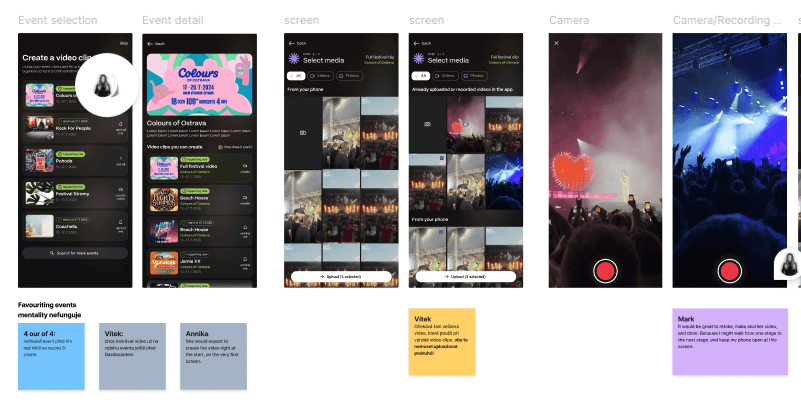
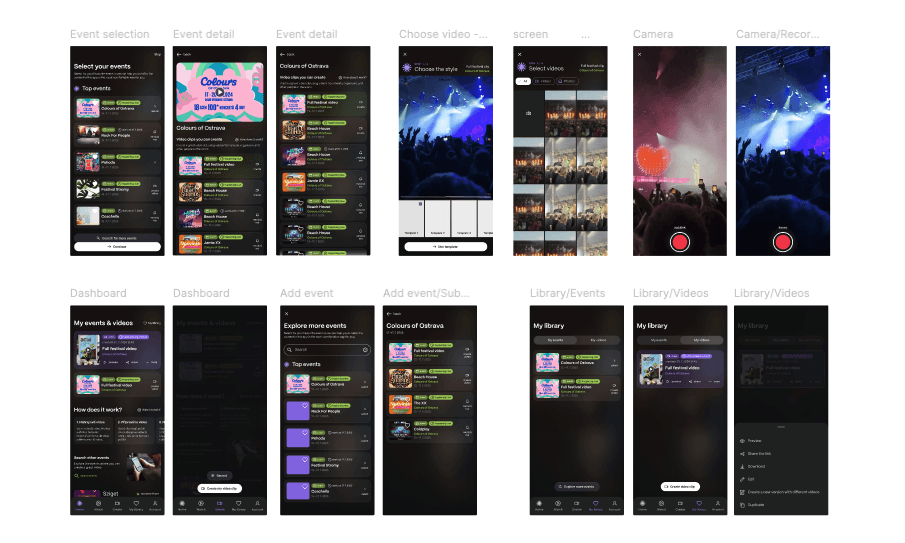
Multiple iterations of wireframes — more than twelve. Then a full rebuild after the first user testing. Not because we were going in circles. Because the screens were how we thought through the product.
The app was the heart of the product. And the hardest thing we built together.
Multiple iterations of wireframes — more than twelve. Then a full rebuild after the first user testing. Not because we were going in circles. Because the screens were how we thought through the product.
Each iteration was a question answered, a direction chosen, a conversation made visible.
Each iteration was a question answered, a direction chosen, a conversation made visible.
The user testing moment
The first round of user testing on the wireframes was a turning point. What we saw was clear: the app was too complex.
The first round of user testing on the wireframes was a turning point. What we saw was clear: the app was too complex.
Users were getting lost before they got to the moment that mattered.
I knew immediately what needed to change, and I brought that direction to the next call.
Users were getting lost before they got to the moment that mattered.
I knew immediately what needed to change, and I brought that direction to the next call.
They agreed. Completely.
We simplified. Radically.
They agreed. Completely.
We simplified. Radically.
And the product became sharper for it.
And the product became sharper for it.
What the app needed to do
The core user journey sounds simple.
The prototype wasn't about
simplifying what existed. It was
about building toward what Foxino
said it wanted to be.
Record your clip at the event.
Upload it.
Receive the final video — your moment, woven together with everyone else's.
Making that feel effortless, at a festival, on a phone, in the middle of a crowd — that's the design problem.
The prototype wasn't about
simplifying what existed. It was
about building toward what Foxino
said it wanted to be.
02 The organizer platform
02 The organizer platform
The other side
Get Moments' business model depended on event organizers.
Get Moments' business model depended on event organizers.
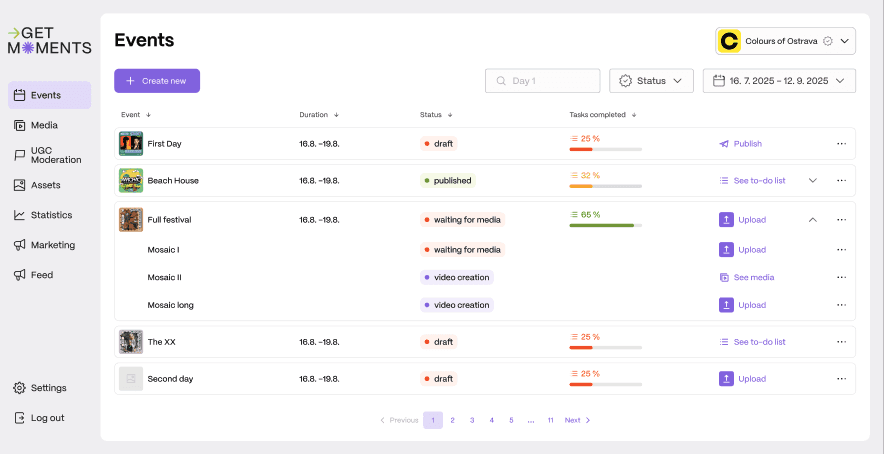
They needed a portal — a place where organizers themselves could manage events, monitor user-generated content, track engagement, and control what went into the final video.
They needed a portal — a place where organizers themselves could manage events, monitor user-generated content, track engagement, and control what went into the final video.
The users here were professionals managing live events at scale.
A completely different set of needs. A completely different design problem.
The users here were professionals managing live events at scale.
A completely different set of needs. A completely different design problem.
I designed the dashboard
I designed the full UX and UI for the organizer portal — dashboards, content management, engagement tracking.
I designed the full UX and UI for the organizer portal — dashboards, content management, engagement tracking.
And I built a design system to sit underneath it.
And I built a design system to sit underneath it.
Not because it was in the brief.
Not because it was in the brief.
Because a product this young, moving this fast, needed a foundation that could grow without breaking.
Because a product this young, moving this fast, needed a foundation that could grow without breaking.
03 Škoda Karaoke
01 I diagnosed the strategic gap.
The activation
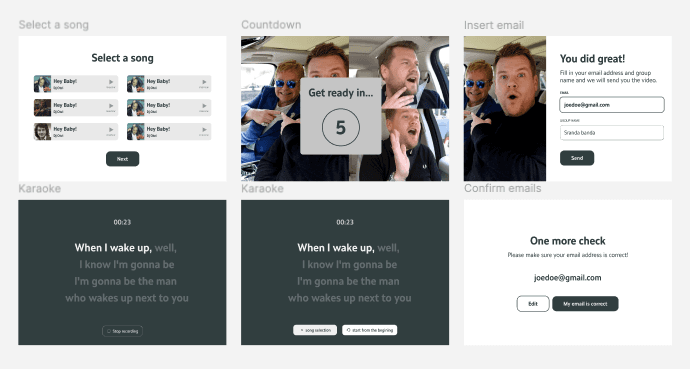
One of Get Moments' early clients was Škoda. The brief: an interactive in-car karaoke experience, showcased at the Ice Hockey World Championship.
One of Get Moments' early clients was Škoda. The brief: an interactive in-car karaoke experience, showcased at the Ice Hockey World Championship.
Fans could sing along inside a Škoda,
capture the moment, share it. A brand activation — playful, shareable, on-brand.
Fans could sing along inside a Škoda,
capture the moment, share it. A brand activation — playful, shareable, on-brand.
I designed the interface.
I designed the interface.
It shipped. It ran. People used it.
It shipped. It ran. People used it.
The mobile app launched at Sziget
The mobile app launched at Sziget
Sziget is one of the biggest music festivals in Europe.
Half a million people over a week.
Sziget is one of the biggest music festivals in Europe.
Half a million people over a week.
Get Moments launched there — live, inside their app, with real festival-goers in real conditions.
Get Moments launched there — live, inside their app, with real festival-goers in real conditions.
Not as a prototype. Not as a pilot.
As a working product at real scale.
It worked.
Not as a prototype. Not as a pilot.
As a working product at real scale.
It worked.
What followed
After Sziget, the co-founders were in conversations with worldwide festival groups.
After Sziget, the co-founders were in conversations with worldwide festival groups.
A product that had been an idea eleven months earlier was now opening doors at the highest level of the live events industry.
A product that had been an idea eleven months earlier was now opening doors at the highest level of the live events industry.
I'm proud of that.
I'm proud of that.
What this kind of partnership
requires.
What this kind of work requires.
The patience
More than twelve wireframe iterations is not a failure of process.
It's what honest product thinking looks like when the brief is still being discovered.
More than twelve wireframe iterations is not a failure of process. t's what honest product thinking looks like when the brief is still being discovered.
Most designers want clarity before they start.
I've learned to work inside the uncertainty — and to help the people I'm working with find their way through it.
Most designers want clarity before they start. I've learned to work inside the uncertainty — and to help the people I'm working with find their way through it.
That patience isn't passive. It's a skill.
The third voice
A two-person founding team — business and tech — will make a product that reflects those two voices.
Sometimes that's enough. Often, something gets lost.
The user. The experience. The moment where the logic of the business
meets the reality of the person holding the phone.
The user. The experience. The moment where the logic of the business meets the reality of the person holding the phone.
That's the voice I bring. Not instead of business or tech. Alongside both.
My thinking is the product.
Figma is how it becomes real.
sarka Kortanova
sarka Kortanova
© 2026 / All rights reserved