Enter password to view case study

Foxino — Product

Strategy &

Redesign

Foxino — Product

Strategy &

Redesign

Brought in to simplify a teacher platform. Ended up

diagnosing why the business, the users, and the team

were all operating from a different version of the same

product — and making that visible for the first time.

Brought in to simplify a teacher platform. Ended up diagnosing why the business, the users, and the team were all operating from a different version of the same product — and making that visible for the first time.

CONTEXT

EDTECH STARTUP — LANGUAGE LEARNING

PLATFORM, CZECH REPUBLIC, 2024

SCOPE

STRATEGY · RESEARCH · IA · PRODUCT DESIGN ·
2 MONTHS

Table of Contents

01 — What I walked into

02 — The three pictures

03 — What I did

04 — Level 01: I diagnosed the strategic gap

05 — Level 02: I reframed the product logic

06 — Level 03: I mapped what was pulling the team

off course

06 — Level 03: I mapped what was pulling the team off course

07 — What changed

08 — What this kind of work requires

The brief

They came to me with a clear brief.

They came to me with a clear brief.

The teacher platform was too complicated. Teachers

weren't using it the way it was designed. Find what's

broken. Fix the UX.

The teacher platform was too complicated. Teachers weren't using it the way it was designed. Find what's broken. Fix it.

Step one

I started where I always start.

I started where I always start.

Not with the screens. With the people.

Not with the screens. With the people.

What I found

Three different realities. Each one internally

consistent. Each one pointing in a different

direction.

Three different realities. Each one internally consistent. Each one pointing in a different direction.

REALITY ONE · THE CEO

"Foxino is a planning tool. A platform

where teachers can plan their entire

class, manage their content, build

toward a full term."

"Foxino is a planning tool. A platform

where teachers can plan their entire

class, manage their content, build

toward a full term."

REALITY TWO · TEACHERS

"We use Foxino for games. Ten, maybe

fifteen minutes at the end of a lesson.

Plan a class with it? We couldn't — it

doesn't have what we'd need for that."

"We use Foxino for games. Ten, maybe

fifteen minutes at the end of a lesson.

Plan a class with it? We couldn't — it

doesn't have what we'd need for that."

REALITY THREE · THE TEAM

Every teacher conversation became a

feature request. Every call left a trace

in the product. The question was

always how to build. Never what to

build. Or why.

Every teacher conversation became a

feature request. Every call left a trace

in the product. The question was

always how to build. Never what to

build. Or why.

The moment

Three realities. One platform.

Three realities. One platform.

The moment I held all three next to each other, the real problem became

impossible to ignore.

The moment I held all three next to each other, the real problem became

impossible to ignore.

It wasn't that the platform was too complicated. It was that they had different ideas about what it was for.

It wasn't that the platform was too complicated. It was that they had different ideas about what it was for.

Reframe

There were real UX problems too. Unclear IA. Button logic

that confused teachers. Animations that obscured content. I

documented them and addressed them.

There were real UX problems too. Unclear IA. Button logic that confused teachers. Animations that obscured content. I documented them and addressed them.

But fixing them alone would not have solved what was

actually broken.

But fixing them alone would not have solved what was

actually broken.

What it actually took

01

I diagnosed the strategic gap

02

I reframed the product logic

03

I mapped what was pulling the

team off course

I mapped what was pulling the team off course

01 I diagnosed the

strategic gap.

01 I diagnosed the strategic gap.

The research

I ran discovery research with five teachers

across five different schools. The goal wasn't to

validate what the team already believed. It was

to understand how teachers actually work.

I ran discovery research with five teachers across five different schools. The goal wasn't to

validate what the team already believed. It was to understand how teachers actually work.

What teachers told me

What I found was consistent across all five interviews. Teachers don't

plan by lesson. They plan by term, by topic, by class level. They recycle

materials from previous years. They use digital tools as boosters — not

as the backbone of their planning.

What I found was consistent across all five interviews. Teachers don't plan by lesson. They plan by term, by topic, by class level. They recycle materials from previous years. They use digital tools as boosters — not as the backbone of their planning.

The false assumption

Foxino was built on a different assumption. One class = one lesson in the

textbook. Linear. Sequential. Self-contained. Logical. But not how any teacher in

the room actually worked.

Foxino was built on a different assumption. One class = one lesson in the

textbook. Linear. Sequential. Self-contained. Logical. But not how any teacher in

the room actually worked.

The missing features

The platform was missing what planning actually requires.

The platform was missing what planning actually requires.

No grammar module.

No way to import or recycle existing materials.

No class templates.

Without these, Foxino could never be a planning tool — regardless of how the

interface looked.

Without these, Foxino could never be a planning tool — regardless of how the interface looked.

The conclusion

This wasn't a UX problem. It was a product

definition problem.

This wasn't a UX problem. It was a product definition problem.

02 I reframed the

product logic.

02 I reframed the

product logic.

The key insight

The research confirmed what the teachers' reality had

already shown. Foxino's CEO wanted it to be a primary

planning tool for teachers. The teachers didn't experience it

that way at all. That gap — between vision and reality —

was the brief.

The research confirmed what the teachers' reality had

already shown. Foxino's CEO wanted it to be a primary

planning tool for teachers. The teachers didn't experience it

that way at all. That gap — between vision and reality —

was the brief.

What that meant

The platform wasn't failing because the interface was

complicated. It was failing because it wasn't built for what

the business needed it to be. Teachers needed a planning

tool. The platform was giving them a games library.

Everything that followed was about closing that distance.

The platform wasn't failing because the interface was

complicated. It was failing because it wasn't built for what

the business needed it to be. Teachers needed a planning tool. The platform was giving them a games library. Everything that followed was about closing that distance.

The mapping

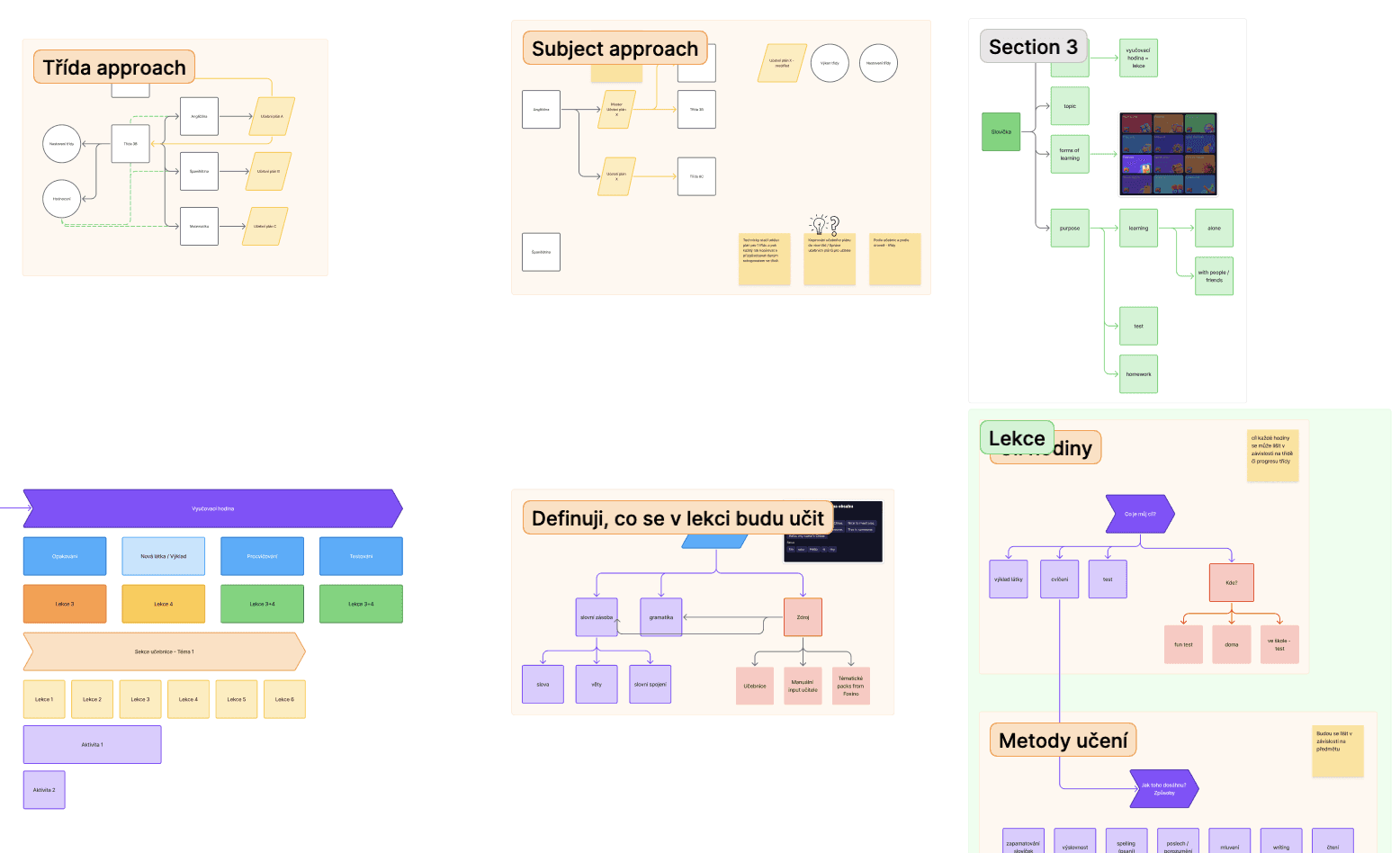
I mapped the entire mental model of

how Czech teachers plan. From

national curriculum down to

individual lesson structure. Every

layer. Then I mapped it against what

Foxino currently offered.

I mapped the entire mental model of how Czech teachers plan. From

national curriculum down to

individual lesson structure. Every

layer. Then I mapped it against what Foxino currently offered.

That gap between how teachers actually plan and what Foxino offered was the redesign brief.

That gap between how teachers actually plan and what Foxino offered was the redesign brief.

The redesign logic

The prototype wasn't about

simplifying what existed. It was

about building toward what Foxino

said it wanted to be.

The prototype wasn't about

simplifying what existed. It was

about building toward what Foxino

said it wanted to be.

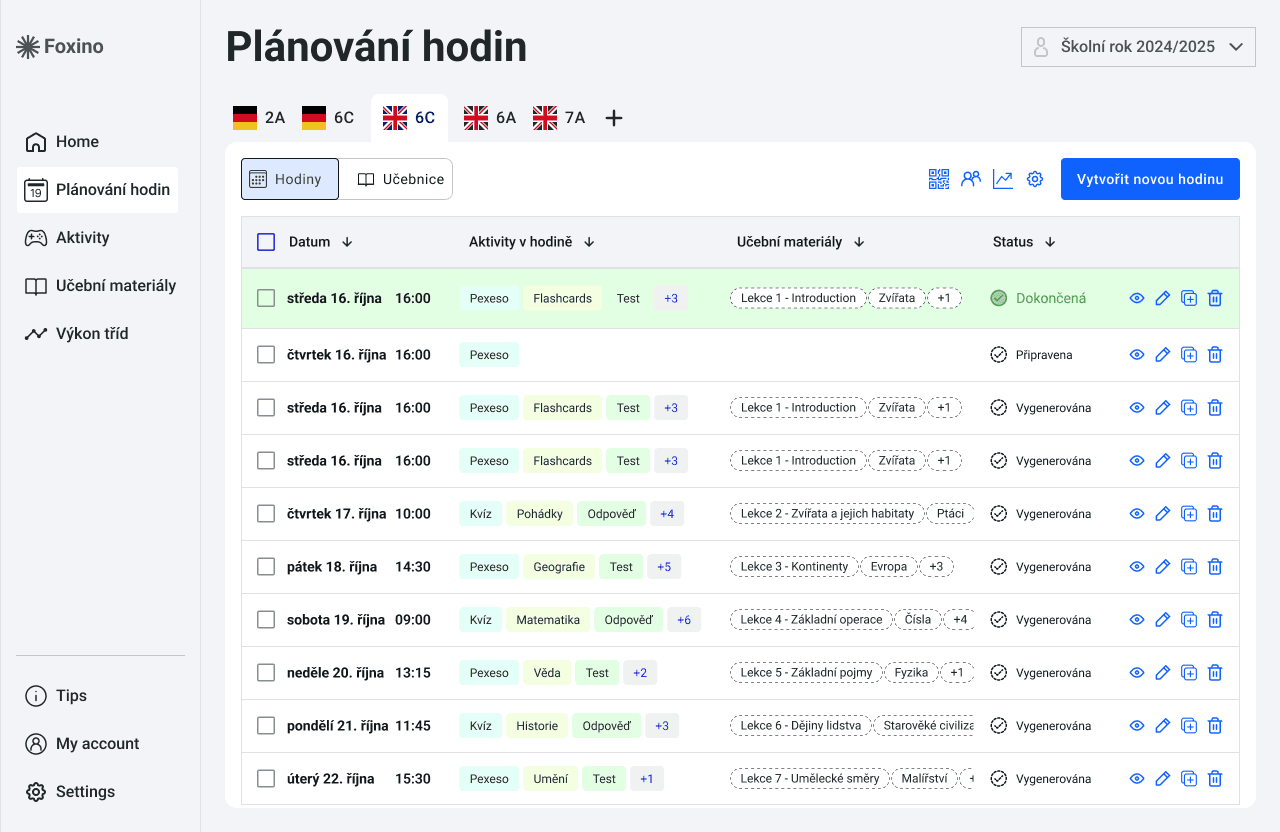
New navigation logic. A structure that reflected how teachers actually move through a term. Grammar, vocabulary, games, homework — each with its own place, not collapsed into a single linear flow.

New navigation logic. A structure that reflected how teachers actually move through a term. Grammar, vocabulary, games, homework — each with its own place, not collapsed into a single linear flow.

The process

Four rounds of presentations. Each one a conversation about direction — not just design decisions.

Four rounds of presentations. Each one a conversation about direction — not just design decisions.

03 I mapped what was

pulling the team off course.

03 I mapped what was

pulling the team off course.

The third problem

The third problem was the one nobody had named at all. It wasn't just what the

team was building. It was how they were making decisions.

The third problem was the one nobody had named at all. It wasn't just what the team was building. It was how they were making decisions.

The three layers

I looked at three things separately:

What users actually needed.

What the business was trying to achieve.

How the development process was really working.

What I saw

The team had no shared direction. Everyone was working

hard but toward different versions of the same product.

Teachers talking directly to developers. Every conversation

becoming a design brief.

The team had no shared direction. Everyone was working

hard but toward different versions of the same product.

Teachers talking directly to developers. Every conversation

becoming a design brief.

The product drifting — not because anyone was doing the wrong thing, but because nobody had connected the three layers into a coherent picture.

The product drifting — not because anyone was doing the wrong thing, but because nobody had connected the three layers into a coherent picture.

What I did

I made that picture visible.

I explained what I was seeing and why it mattered.

What happened next was up to them.

What changed

What changed

There are no metrics here. I was brought in mid-stream, and I left before anything shipped.

There are no metrics here. I was brought in mid-stream, and I left before anything shipped.

The research gave the team a precise picture of how teachers actually work — and what was standing between Foxino and its own ambition.

The research gave the team a precise picture of how teachers actually work — and what was standing between Foxino and its own ambition.

That kind of clarity is hard to measure.

It's also where the most important decisions get made.

That kind of clarity is hard to measure.

It's also where the most important decisions get made.

What this kind of work
requires.

What this kind of work requires.

The diagnos is problem

Most companies don't know they have a strategy problem.

They think they have a UX problem. Or a research problem. Or a prioritisation problem. The symptoms are real. The diagnosis is wrong.

What it actually takes

Getting to the real problem requires someone who:

Can hold a strategic question — what are you actually building, and for whom? — while also doing the research, mapping the logic, and making it all visible in something concrete.

Is in the room with the CEO and also in the user interviews.

Can see across all three layers — user, business, process — and connect them into a picture the whole team can work from.

My thinking is the product. Figma is how it becomes real.

Contact

Let's work together

Sometimes the problem isn't what it looks like. If you're stuck, I can help you figure out what's actually going on — and what to do about it.

Contact

Let's work together

Sometimes the problem isn't what it looks like. If you're stuck, I can help you figure out what's actually going on — and what to do about it.

sarka Kortanova

sarka Kortanova

© 2026 / All rights reserved